- Find Current Bus Route Schedules through June 13 and Plan Trips after June 14 Read More
DART Funding
Public Transit
DART’s budget reflects a collaborative effort among our member communities to balance the interests of transit riders, taxpayers and the communities we serve.
Public transit is essential infrastructure that supports a thriving region. Every day, DART connects thousands of central Iowans to jobs, healthcare, education and other opportunities that promote a healthy life. These connections benefit all residents by helping fill jobs we depend on, attract new business and compete as a metro with other cities.
Public transit is one of the most efficient and effective public services funded with our tax dollars. DART carries a higher-than-average number of passengers per hour at a lower cost per boarding on average than similar size transit systems around the country.
View the FY 2027 Budget Book.
How is DART funded?
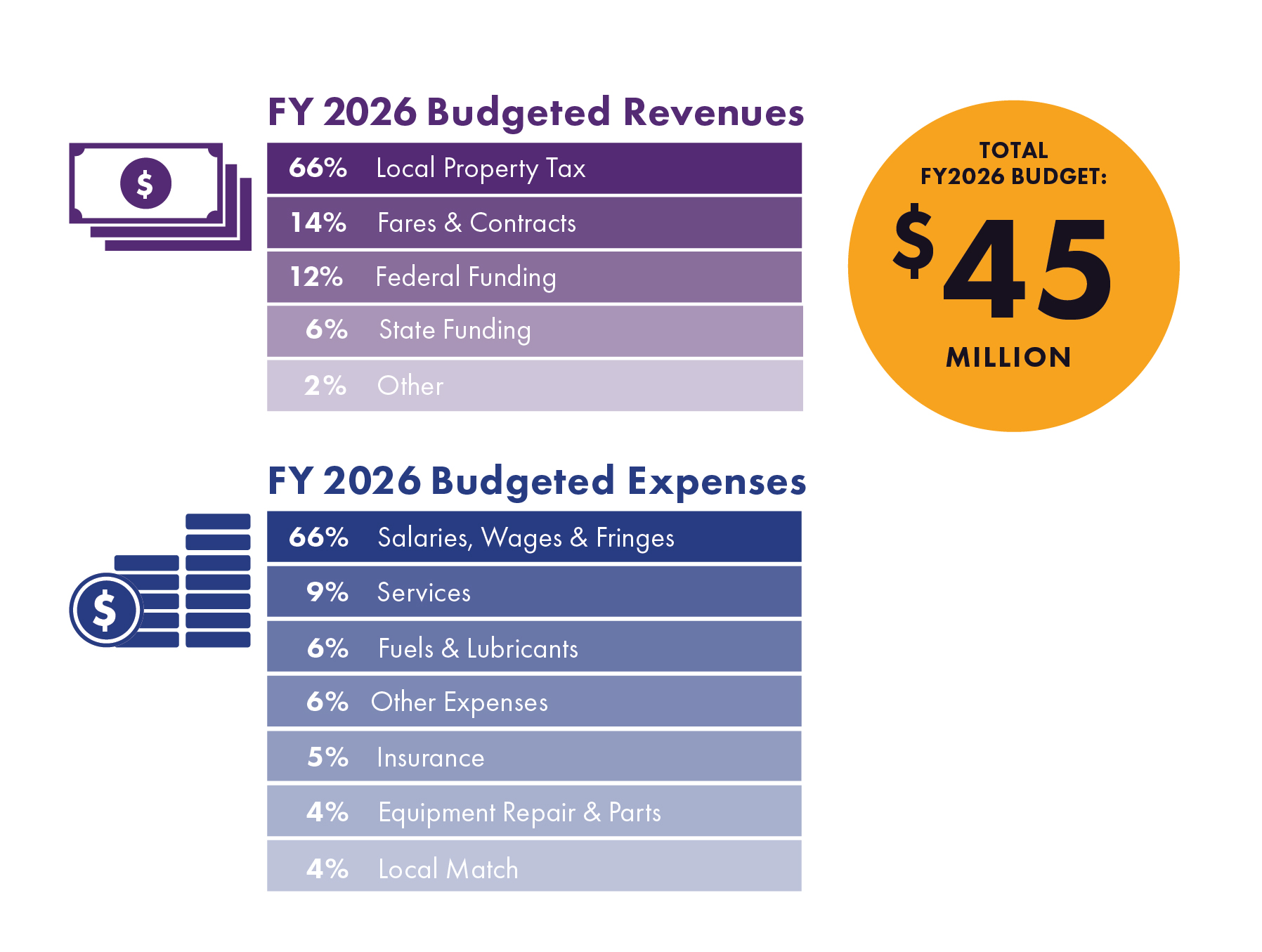
All U.S. transit agencies receive public funding because they provide a public service, just like roads, parks and libraries. A mix of federal, state and local dollars allows DART to provide services that result in 3.75 million rides in a year (more than the Des Moines International Airport!).
In Iowa, public transit is funded through property taxes, the funding mechanism set by the Iowa Legislature. The local property tax levy funds 66% of DART’s total operating revenue.
The transit levy is approximately 1-2% of a property owner’s total tax bill. This ranges from about $50-$100 per year for someone who owns a $200,000 home.
Learn about the return on investment in transit.
How does the property tax levy work?
DART’s governing body, the DART Board of Commissioners, decides the property tax formula that determines how much each community contributes to DART and sets the levy rates each year when it adopts a budget.
The Commission is focused on how to make the property tax levy work better for member communities as part of a regional system, while also reducing DART’s reliance on property taxes by seeking assistance from the Iowa Legislature for more diverse and sustainable sources of funding. To date, the only additional funding option the Legislature has authorized is allowing the City of Des Moines to increase its franchise fee—a tax on gas and electric bills—by up to 2.5% to fund public transit, which the Des Moines City Council approved in fall 2025.
How the formula impacts community contributions
The DART Commission adopted a new funding formula that is being phased in over several years. The new formula assigns how much each member community contributes to DART based on population and level of DART services received. Urban areas are seeing increases in their local levies to match higher service levels in more populated areas, while many member communities are seeing decreases in their transit levy.
The new formula has resulted in Des Moines’ contribution exceeding the maximum amount of property taxes DART can collect to fund public transit per state law and is why the Legislature authorized the city to increase its franchise fee an additional 2.5% to maintain transit service or reduce the transit levy.
DART’s current operating budget
DART is operating with a balanced budget of $45 million through June 30, 2026. This budget covers the cost of providing services to member communities in Greater Des Moines.
The FY 2026 Budget Book highlights how DART has maintained services and limited property tax revenue growth, even with budget pressures that include:
- No longer utilizing one-time federal relief dollars
- State changes to programs and policies that have decreased revenue.
- Inflation causing cost increases for bus parts, insurance, labor and other items needed to deliver service.
Over the past several years, DART has limited annual expense growth to an average of 4%. We have cut more than $1 million in annual expenses, including eliminating administrative positions, ending the under-performing D-Line shuttle and removing Wi-Fi from buses.
DART’s approved budget for next fiscal year that starts July 1, 2026, is $43.8 million, which reflects a 2.65% expense cut. The budget accounts for DART providing 10% fewer service hours in the new bus network that launches on June 14, 2026. It also balances the budget without using any one-time funds.
Frequently Asked Questions
DART’s budget, including how much local taxpayers contribute and how much service DART can provide, is determined by our governing board, made up of an elected leader from each member community.
We are committed to being good stewards of the funding we receive. A 2025 federal government review reaffirmed DART’s commitment to compliance, financial stewardship and strong management practices. An annual external audit affirmed the highest rating for adhering to strong financial oversight and budgeting practices.
DART’s operating budget is separate from our capital budget, which is primarily funded by federal dollars and used for infrastructure needs, such as bus purchases and building repairs. Constructing a new Operations & Maintenance Facility is covered under DART’s capital budget.
Public transit agencies are designed to provide a public service, not make a profit. All public transit operating budgets require local taxes, typically in the range of 60-80%, because the fare revenue transit agencies collect does not cover the cost of operating the service.
We must balance what we can charge with fares with what people can pay. More than 60% of current riders have an annual income of less than $30,000, while most of our riders are using the bus system to get to work.
Fixed-route service is still the most cost-effective way of providing public transit services. DART Fixed Route services average 18 passengers per service hour. Some of DART’s busiest routes average up to 27 passengers per hour.
Per capita spending on public transit in Greater Des Moines is less than many of the midwestern cities we compete with for talent and economic development opportunities.
DART and its Board of Commissioners have worked for several years to educate Iowa lawmakers on options to diversify revenue and reduce reliance on property tax. Other transit agencies are funded through methods, such as a sales tax, income tax or a motor vehicle tax. DART will continue to educate elected officials on these other options for funding public transit.
For most riders, public transit is the only means they have to get to work and to access services and opportunities in our communities. Most riders have one or no working vehicles (86%) in their household and an annual income less than $30,000 (64%).
In addition to providing day-to-day essential services, DART also supports the community with its pressing needs. For example, when temperatures are dangerously high, we provide free rides to cooling centers. When big events happen – like the Iowa State Fair – we connect tens of thousands of Iowans safely and efficiently to these opportunities.